
Every agency pitch now comes with at least one new acronym. If you have been asked to choose between SEO, AEO and GEO, the GEO vs SEO question is usually where people get stuck, so this guide answers it plainly and then helps you decide where your own budget should go.
The short version: they are not three competing services. They are three places your business can show up when someone searches, and the work behind them overlaps far more than most pitches admit.
What is the difference between SEO, AEO and GEO?
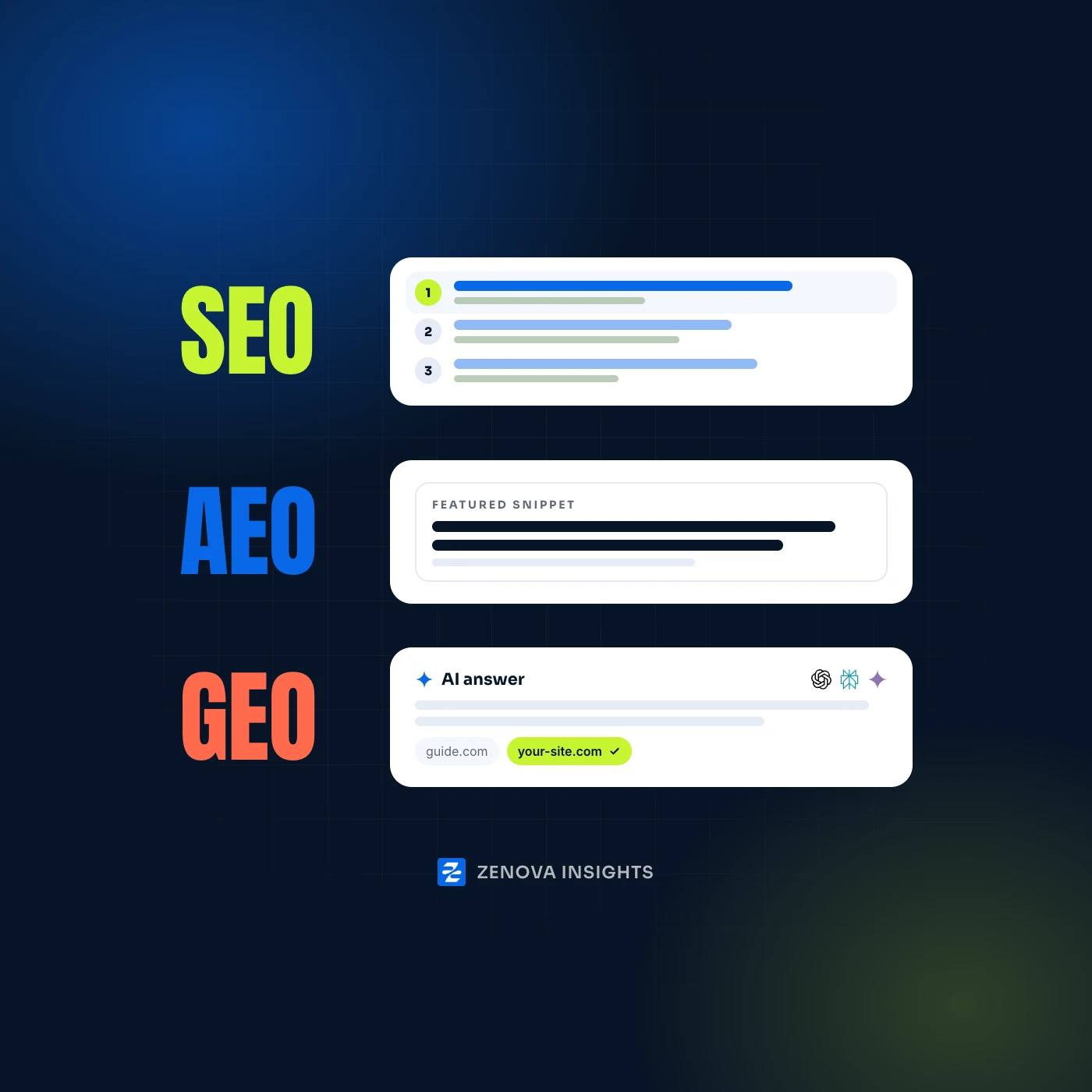
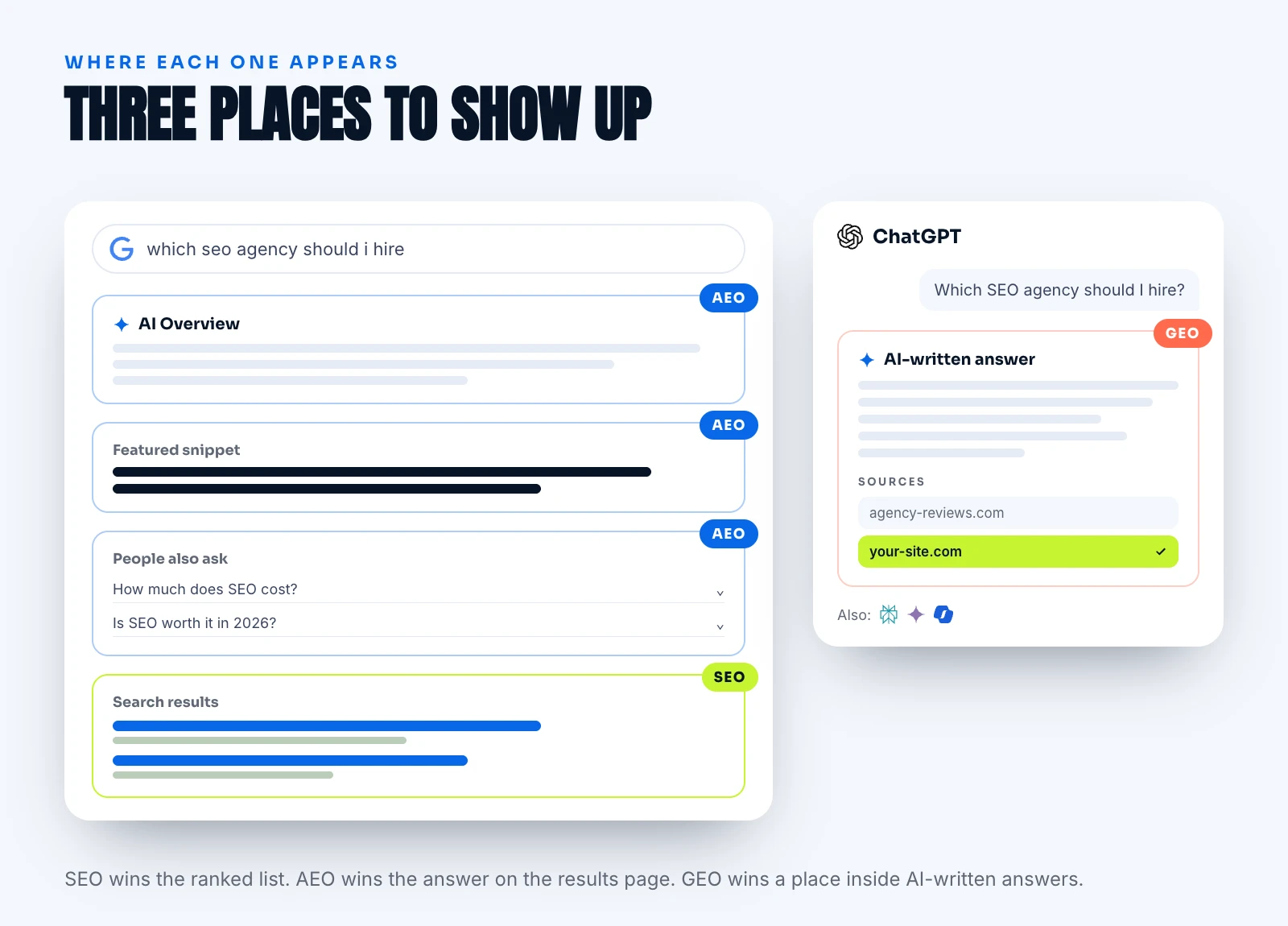
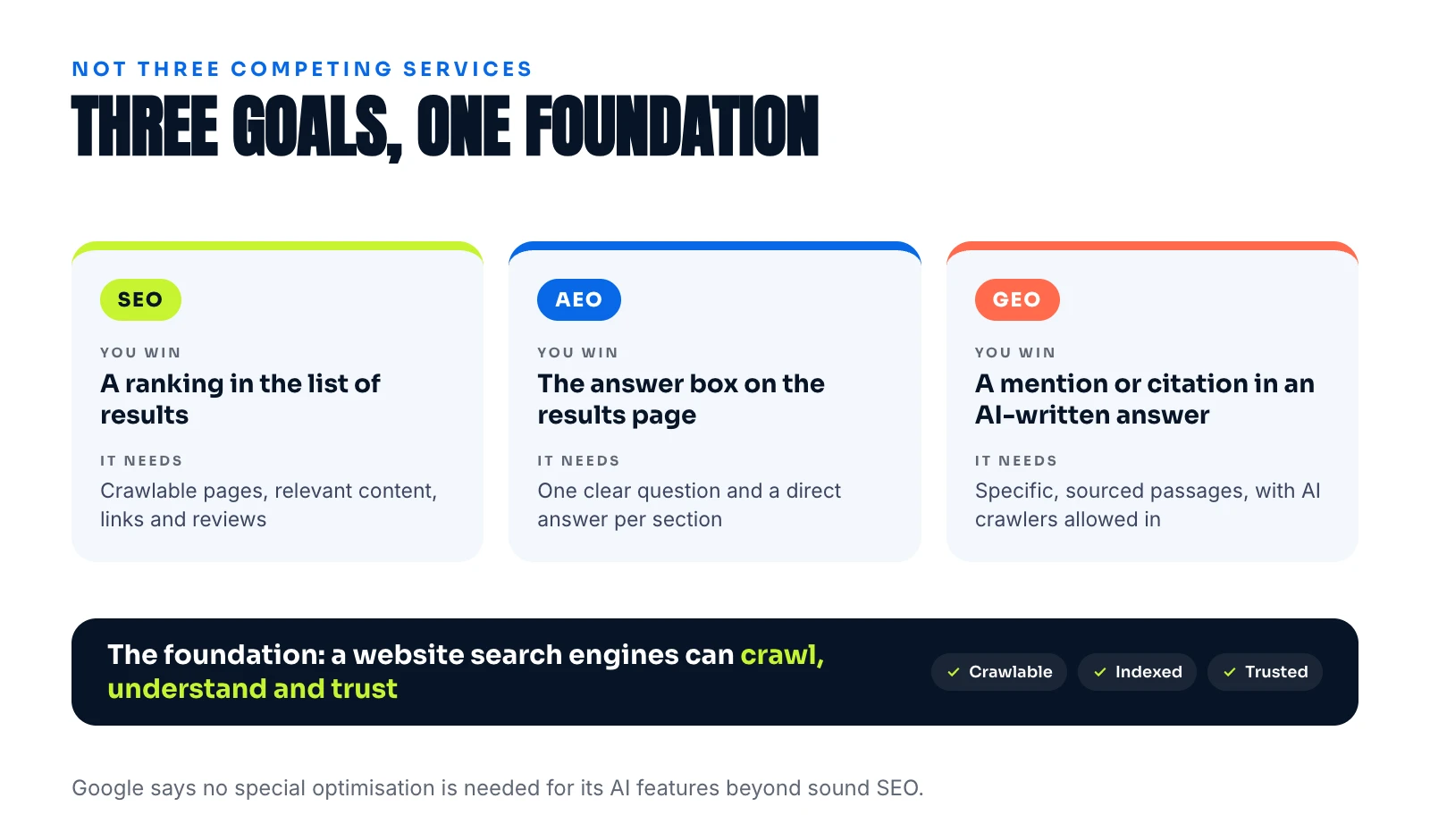
SEO gets your pages ranked in the list of search results, AEO gets your answer shown directly on the results page, and GEO gets your business named or cited inside answers written by AI tools such as ChatGPT, Perplexity and Google's AI Mode. All three rest on the same foundation: a website that search engines can crawl, understand and trust.
SEO | AEO | GEO | |
|---|---|---|---|
What you are trying to win | A ranking in the list of results | The answer box on the results page | A mention or citation in an AI-written answer |
Where it appears | Google and Bing results, Google Maps | Featured snippets, People Also Ask, AI Overviews | ChatGPT, Perplexity, Gemini, Copilot, Google AI Mode |
Who decides | The search engine's ranking systems | Google's systems; you cannot mark a page for it | The AI tool, which picks the sources it reads and quotes |
What it needs from you | Crawlable pages, relevant content, links and reviews | One clear question and a direct answer per section | Specific, sourced passages, with AI crawlers allowed in |
Where we would start it first | Local businesses, and anyone with little search traffic yet | Businesses whose buyers ask many questions before they buy | Brands whose buyers compare options before they get in touch |
Does SEO still matter now that AI answers questions?
Yes, because Google's AI features are built on top of ordinary search. Google says a page only needs to be indexed and eligible to be shown in Google Search with a snippet to appear as a supporting link in AI Overviews or AI Mode, with no extra technical requirements.
What has changed is what a ranking is worth. Pew Research found that people who saw an AI summary clicked a traditional result in 8% of visits, compared with 15% when no summary appeared. A strong ranking still matters. On questions that AI answers, it simply brings fewer clicks than it used to.
What is AEO, and how is it different from SEO?
AEO, or answer engine optimisation, is the work of becoming the answer a search engine shows on the results page itself, rather than a link the searcher still has to click. Its oldest form is the featured snippet, which Google describes as "special boxes where the format of a regular search result is reversed".
The catch is that you cannot apply for it. Google says its own systems decide whether a page would make a good featured snippet, and to the question of whether you can mark a page to be chosen, its documentation answers "You can't".
What you can do is write the way answers get picked: one question per section, answered in the first two sentences, then explained. Every section of this guide is written that way, so you can see the format in use.
What is GEO, and how is it different from AEO?
GEO, or generative engine optimisation, aims for a place inside answers that AI tools write from several sources, rather than a single answer box lifted from one page. A widely cited study, GEO: Generative Engine Optimization, presented at KDD 2024, found that adding citations, quotations and statistics could raise a source's visibility in AI-generated answers by up to 40%.
Search engines have started using the name too. According to Search Engine Journal, Bing added GEO to its webmaster guidelines in February 2026 and described it as content eligibility for grounding and reference in AI responses.
GEO also has a plain technical side. OpenAI says sites that block its OAI-SearchBot crawler are not shown in ChatGPT search answers, so letting the right crawlers in comes before any writing.
Is GEO vs SEO a real choice?
No. GEO builds on SEO rather than replacing it, and Google says there are no special optimisations necessary to appear in its AI features beyond sound SEO.
The names are still settling. Wikipedia's entry on generative engine optimisation lists answer engine optimisation and artificial intelligence optimisation as related terms, and you will see agencies, Zenova included, use the three side by side.
So when someone sells you GEO as a replacement for SEO, ask what they will do differently. If the answer is "write clear content and get cited", that is good SEO with a new label, and it should be priced like it.
Which one does your business need?
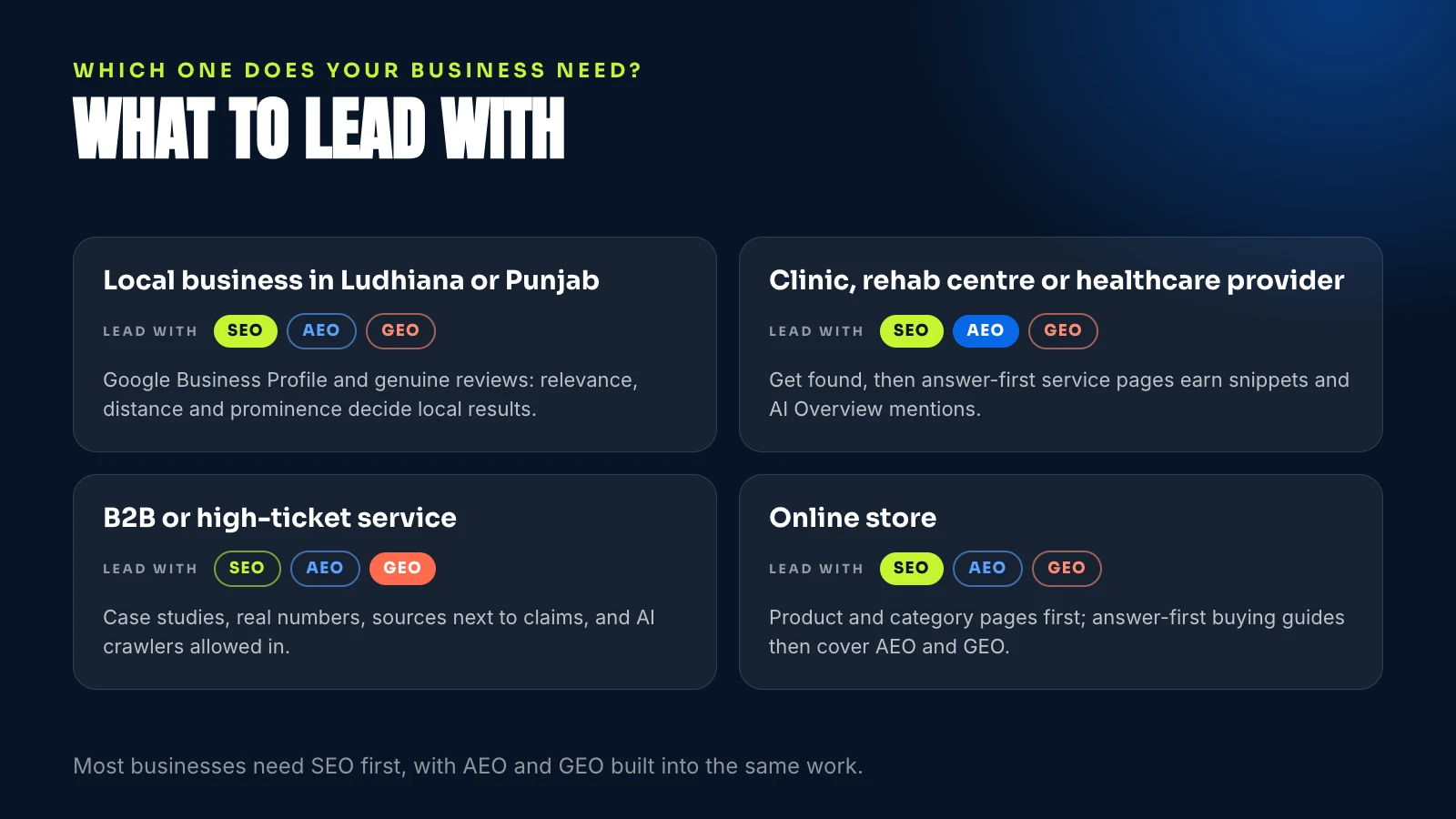
Most businesses need SEO first, with AEO and GEO built into the same work, but the balance shifts with how your customers buy. A business that sells to people nearby should lean on local SEO, while a business whose buyers research for weeks should put more into answer-first content that AI tools can quote.
Here is how we would weigh it:
A local business in Ludhiana or anywhere in Punjab. Start with SEO, and specifically your Google Business Profile. Google says local results are based mainly on relevance, distance and prominence, and a complete profile with genuine reviews is where you control most of that.
A clinic, rehab centre or other healthcare provider. Your buyers ask careful questions before they call. SEO gets you found, and answer-first service pages earn the snippets and AI Overview mentions that build trust before the first conversation.
A B2B or high-ticket service. Buyers compare options, often inside ChatGPT or Perplexity. Put more into GEO: specific case studies, real numbers, sources linked next to claims, and AI crawlers allowed in.
An online store. SEO on product and category pages still does most of the work. Answer-first buying guides then cover AEO and GEO at the same time.
Where should you start if your budget only covers one?
Start with SEO foundations, then write every new page in an answer-first format, because that one habit serves AEO and GEO at the same time. In practice that means fixing crawling and indexing, checking that AI crawlers are not blocked, and answering one question per section in its first two sentences.
After that, spend on proof rather than volume. One case study with real numbers and a named client gives an AI tool more to quote than ten generic blog posts.
How do you measure SEO, AEO and GEO?
Measure SEO with rankings, clicks and enquiries; AEO with how often your pages appear in featured snippets, People Also Ask and AI Overviews; and GEO by asking AI tools the questions your buyers ask and recording whether you are named. We have not found a single report that covers all three, so a monthly log of 20 to 30 real buyer questions is still the most honest measure we know.
We explain how to build that log in How AI search picks who to cite. Keep it next to Search Console, so you can see whether the page that ranks is also the page being quoted.